From Plant to Product: The Traditional Harvesting of Aloe Ferox
There’s something special about knowing where a product comes from.
In a world of mass production and quick fixes, the story behind Aloe Ferox reminds us that some of nature’s most valuable gifts still begin with skilled hands, time-honoured knowledge, and a deep respect for the environment.
At Ruby Tulip & Co., we love sharing the stories behind the products we stock, and few are as fascinating as the traditional harvesting process of South Africa’s own Aloe Ferox, also known as the Cape Aloe.
A Proudly South African Plant
Aloe Ferox is indigenous to South Africa and naturally grows across the Southern Cape, Eastern Cape, southern parts of KwaZulu-Natal, the Free State, and Lesotho.
For centuries, local communities have recognised the remarkable properties of this resilient plant. In fact, records show that Aloe bitter sap was first harvested in the Albertinia area as early as 1773, when it was exported to Germany for medicinal purposes.
Today, Aloe Ferox products are enjoyed both locally and around the world, but many of the traditional harvesting methods remain beautifully unchanged.
Understanding the Aloe Ferox Leaf
Each Aloe Ferox leaf contains two distinct substances:
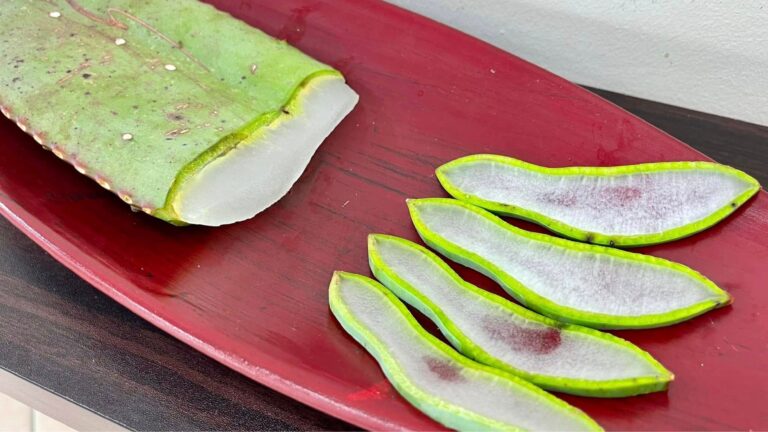
Yellow Bitter Sap – found just beneath the leaf surface and traditionally valued for its medicinal properties.
White Aloe Gel – the soothing inner jelly commonly used in skincare and wellness products.
When a leaf is cut, the yellow bitter sap flows freely from the leaf, making it possible to harvest naturally without damaging the entire plant.
Harvesting with Care and Sustainability
One of the reasons Aloe Ferox is so remarkable is the sustainable way it is harvested.
Rather than stripping the entire plant, harvesters carefully remove only the bottom two rows of mature leaves each year. These mature leaves contain the highest concentration of beneficial compounds while allowing the plant to continue growing and thriving.
Typically, four to eight leaves are harvested from a plant, cut as close to the stem as possible.
This thoughtful approach helps ensure the long-term health of both the plant and the surrounding ecosystem.
The Traditional Collection Process
Once harvested, the leaves are arranged using a method that has been passed down through generations.
A shallow hole is made in the ground and lined with a plastic sheet. The freshly cut leaves are then stacked in a circle around the hole, with their cut ends facing inward.
As the leaves rest, the golden-yellow bitter sap slowly drains from the cut edges and collects in the centre.
Each harvesting stack contains approximately 200 to 400 leaves, and every leaf produces an average of 5–15 ml of bitter sap.
It’s a simple process, yet one that relies on patience, skill, and an understanding of the plant.
From Sap to Crystals
Once collected, the bitter sap undergoes another fascinating transformation.
The liquid sap is carefully boiled, allowing much of its water content to evaporate. As it reduces, it becomes thicker and more concentrated, shrinking by approximately 50%.
When cooled, the concentrated sap hardens into solid lumps. These are then broken down into smaller crystals and powder, ready to be used in a variety of Aloe Ferox products.
It’s a process that reflects the beauty of traditional craftsmanship—taking something straight from nature and transforming it into a valuable natural ingredient.
Why This Matters
Understanding how Aloe Ferox is harvested helps us appreciate more than just the final product.
It tells a story of:
Sustainable harvesting practices
Generations of local knowledge
Respect for nature’s rhythms
South African heritage and innovation
Every Aloe Ferox product begins long before it reaches a shelf. It starts in the landscapes of South Africa, where skilled harvesters carefully collect nature’s gifts while ensuring future generations can continue to do the same.
A Natural Legacy Worth Celebrating
At Ruby Tulip & Co, we’re passionate about products with purpose—items that are thoughtfully made, rooted in tradition, and inspired by nature.
The journey of Aloe Ferox from plant to product is a beautiful reminder that some of the best things cannot be rushed. They are cultivated with care, harvested responsibly, and crafted with respect for both people and the environment.
And perhaps that’s what makes Aloe Ferox so special—not just what it does, but the story it carries with it.
A little piece of South African heritage, thoughtfully shared with the world.